Grok Voice 3.0 is out: it leads the voice index, keeps the price, and swapped the model for everyone on the alias
SpaceXSI, formerly xAI, launched Grok Voice 3.0 on 14 October at the same US$ 0.08 per minute as the previous version. It leads five of the six measurements in the announcement, loses the support-call test to GPT-Live-1, and is already live in every agent that uses grok-voice-latest.

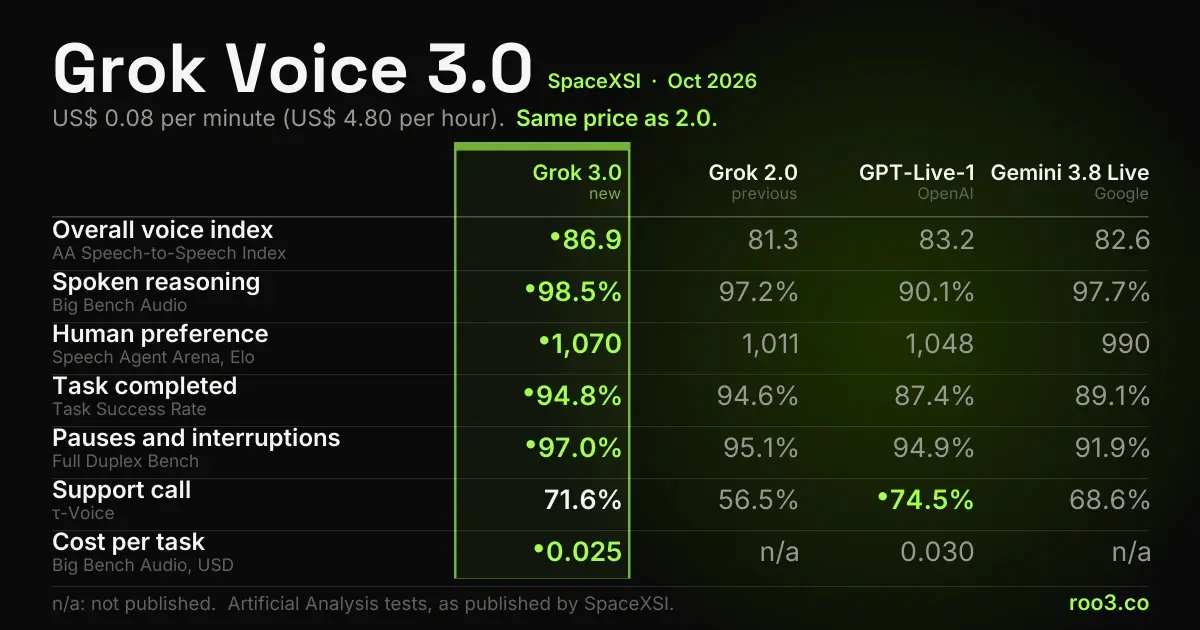
Grok Voice 3.0 is the new speech-to-speech model from SpaceXSI, formerly xAI, released on 14 October 2026. It costs US$ 0.08 per minute, the same as Grok Voice 2.0, and uses the same API. In the Artificial Analysis tests the company published, it leads the voice index at 86.9 and wins five of six measurements, but trails OpenAI's GPT-Live-1 on the support-call test (71.6% against 74.5%). Anyone using the grok-voice-latest alias has been on the new model since launch day without changing anything, and the documentation itself recommends pinning the version in production.
What you get from this article
- The identifier is grok-voice-3.0, and the grok-voice-latest alias started pointing to it on 14 October. Version 2.0 is deprecated, with no shutdown date published.
- Pricing did not change: US$ 0.08 per minute of conversation, or US$ 4.80 per hour, plus US$ 0.004 per text input.
- On the Artificial Analysis speech-to-speech index it scores 86.9, against 83.2 for GPT-Live-1 and 82.6 for Gemini 3.8 Live.
- On the support-call test with accents, noise and interruptions, GPT-Live-1 comes out ahead: 74.5% against 71.6%.
- GPT-Live-1 is cheaper per minute (US$ 0.05) but bills the backend reasoning model separately. Per task, the measurement the company cites puts Grok lower.
- Brazilian Portuguese is one of the 20 languages in the documentation, and phone calls come in over SIP.
- Reasoning is on by default in 3.0. Anyone who tuned a script for 2.0 may see the agent behave differently without changing a line.
What shipped, and where it already runs
Elon Musk wrote on X on 14 October 2026 that Grok Voice 3.0 is now the world's leading conversational voice model. The post quoted Artificial Analysis, a company that measures AI models, which placed the launch first on its speech-to-speech index. The same day, SpaceXSI, the name the former xAI now uses on its site and documentation, published the official announcement and the API update.
The confirmation does not rest on a screenshot. The API documentation lists the identifier grok-voice-3.0 as the flagship voice model, says the grok-voice-latest alias now points to it, and marks grok-voice-2.0 as deprecated. The release notes repeat both points. There is no shutdown date for the old version yet.
Speech-to-speech means the model listens and answers in audio over the same connection, without a transcription step and a separate read-aloud step. It is the piece that lets a virtual agent handle interruptions, pauses and turn-taking the way a person does. The company says the model already handles millions of conversations a day in Tesla cars and in Grok's voice mode, and that Starlink's call centers take about 20,000 calls a day through it.
The announcement table, with all six measurements
The numbers come from Artificial Analysis, which tests models independently, but SpaceXSI chose which results to show. The comparison is against Grok Voice 2.0, OpenAI's GPT-Live-1 (backed by GPT-6 Astra at medium effort) and Google's Gemini 3.8 Live with extended thinking.
Grok Voice 3.0 posts the top score in five of the six rows. The exception is the one that matters most to a business: τ-Voice, which simulates support calls with different accents, background noise and customers who interrupt. There GPT-Live-1 scores 74.5% against 71.6% for Grok. SpaceXSI calls the result comparable and points out that Grok takes 40% less time to the first sound.
| Grok Voice 3.0 new | Grok Voice 2.0 previous | GPT-Live-1 OpenAI, Astra medium | Gemini 3.8 Live Google | |
|---|---|---|---|---|
| Overall voice index Artificial Analysis Speech-to-Speech Index | 86.9 | 81.3 | 83.2 | 82.6 |
| Spoken reasoning Big Bench Audio | 98.5% | 97.2% | 90.1% | 97.7% |
| Human preference Speech Agent Arena, Elo score | 1,070 | 1,011 | 1,048 | 990 |
| Task completed Task Success Rate | 94.8% | 94.6% | 87.4% | 89.1% |
| Pauses, turns and interruptions Full Duplex Bench | 97.0% | 95.1% | 94.9% | 91.9% |
| Support call τ-Voice | 71.6% | 56.5% | 74.5% | 68.6% |
| Cost per task Big Bench Audio, in dollars | US$ 0.025 | not published | US$ 0.030 | not published |
The jump over the previous version lands where support calls hurt. On τ-Voice Grok went from 56.5% to 71.6%, more than 15 points, and on human preference it gained 59 Elo points. Elsewhere in the table 2.0 was already high, and the gain is one to five points. Outside the table, SpaceXSI cites EVA-Bench, ServiceNow's benchmark for enterprise voice agents with more than 200 scenarios, where the model scored 74% accuracy, the highest result published.
Pricing: unchanged, and the comparison that misleads
Grok Voice 3.0 costs US$ 0.08 per minute of conversation, or US$ 4.80 per hour, exactly the price of 2.0. The price sheet adds US$ 0.004 per text input, which is when your system sends a written message into the conversation. A 4-minute call costs US$ 0.32 in voice. A thousand calls that long per month come to US$ 320.
On the per-minute sheet alone, OpenAI looks cheaper: GPT-Live-1 costs US$ 0.05 per minute, billed by the second. The difference is in OpenAI's own fine print. GPT-Live-1 handles the conversation but hands reasoning and tool use to a backend model, and that model is billed separately at its normal rate. In the table's configuration the backend is GPT-6 Astra, which costs US$ 10 per million input tokens and US$ 50 per million output tokens.
That is why the measure that really compares is cost per task. In the Artificial Analysis spoken-reasoning test, a task cost US$ 0.025 with Grok, US$ 0.030 with GPT-Live-1 backed by Astra, and US$ 0.055 with GPT-Realtime-2.1, the OpenAI model billed per audio token (US$ 32 per million input and US$ 64 per million output). It is a single test, chosen by the seller, but it makes the point: price per minute and price per task can point in opposite directions.
In voice, the per-minute price is only the line rate. What reaches the invoice is the minute plus everything the model had to call to solve the problem.
The alias that swaps the model for anyone who did not pin a version
The announcement says agents using grok-voice-latest "have already been switched over automatically, with no changes needed". For someone just starting out, that is convenient. For a company with a support agent in production, it means the model talking to its customers changed on 14 October without going through any test of theirs.
It is not the first time. On 5 August 2026 the same alias started pointing to Grok Voice 2.0, and in our account the per-minute price went from US$ 0.05 to US$ 0.08 along with it, without a single line of code changing. This time the price stayed put, but the behavior did not: in 3.0 reasoning is on by default at high effort, and the documentation recommends shortening the agent's script and removing patches written for the previous version. A script tuned for 2.0 may behave differently on 3.0.
The documentation itself resolves the contradiction in a note: use the alias for new integrations, and pin the version in production. At ROO3 we have both cases. The voice assistant in Tobia, our CRM, uses the alias and moved to 3.0 on launch day without a deploy; we have not measured the difference yet. Gerar Treino, on gerar.app, interviews users by voice and was pinned to version 2.0 precisely after the August surprise. Now that 2.0 is deprecated, the switch will happen, but only after running the whole script on the new model.
What matters for customer support in Brazil and beyond
Brazilian Portuguese is one of the 20 languages listed in the documentation, next to European Portuguese, and the model detects the caller's language on its own. One detail is costly if missed: to give the model a language hint for Portuguese, you have to send pt-BR or pt-PT. The documentation warns that bare pt is not accepted and that unrecognized codes are silently ignored, with no error.
For real customer support, the rest of the list carries more weight:
- Phone: calls come in over SIP, WebSocket or LiveKit, with native support for the G.711 codec, the telephony standard. You can connect the agent to a PBX or a call-center number.
- Tools during the conversation: search over your own documents, web and X search, MCP servers and your own functions, which is how the agent checks a CRM, books an appointment or opens a ticket while talking.
- Your own voice: you can clone a voice from a short audio clip and use it instead of the catalog voices.
- Resumed conversations: a dropped call can come back with its history, as long as it reconnects within 30 minutes.
- If you already use OpenAI: migrating from the Realtime API means changing the base URL, the key and the model. The documentation lists the few event differences between the two APIs.
The Starlink case is the announcement's commercial argument: about 70% of calls resolved without a human, and one in four sales calls ending in a purchase before the caller hangs up. These are the company's own numbers, with no published audit and no definition of what counts as resolved. They work as a ceiling for what a well-designed flow can do, not as a forecast for another business.
What we learned putting Grok's voice in production
ROO3 has used SpaceXSI's voice API in two products since August: the voice assistant in Tobia and the voice interview in Gerar Treino. The lessons below come from Grok Voice 2.0. According to the documentation the 3.0 API is the same, so they still apply.
- Billing runs per minute of open session. Silence costs money. A conversation that ends but does not close keeps the meter running. We had to close on inactivity and give the agent a tool to hang up on its own when the conversation is over.
- The model does not know what time it is. The script asked it to start wrapping up around minute 8, and the agent wrapped up at minute 3, with half the questions unasked. Time-based instructions do not work. A closed list of questions, with the mandatory ones marked, does.
- Audio goes straight from the browser to SpaceXSI. The server only issues a single-use token. That keeps latency low, but it takes away the server's ability to cut a conversation mid-call. Control becomes a cap on time and spend, counted on the server and never from what the browser reports.
- Event order matters. Audio sent before the session confirms its configuration is decoded in the wrong format, with no error, and the agent answers noise.
None of these points shows up in a launch table, and all of them affect the cost or quality of the conversation. Before putting a voice agent in front of customers, a test with ten real calls is worth more than any index.
What to do this week
If you only use Grok's voice mode in the app, there is nothing to do: the new model is already there.
If you have a voice agent in production or are choosing one, these are the decisions:
- If your agent uses
grok-voice-latest, it has been on 3.0 since 14 October. Listen to twenty real calls from this week and compare them with earlier ones before moving on. - If you pinned
grok-voice-2.0, it is deprecated. Run your script ongrok-voice-3.0, shorten the prompt as the documentation suggests, and only then switch. - If you use OpenAI's Realtime API, compare cost per complete call, not per minute. GPT-Live-1 has the lower line rate and bills the backend separately.
- If you are starting voice support, begin with a closed flow such as scheduling, invoice copies or triage, with a handoff to a human when the agent cannot solve it.
- Do the math before going live: minutes per call, times calls per month, times US$ 0.08. And set a spending cap that the system itself enforces.
A voice agent that serves customers is a process project, not a model project: script, tools, human handoff and cost math come before choosing who does the talking. That is how ROO3 builds these projects in its AI consulting for businesses, starting with a test call on your real case. If the question is still where to begin, our article on WhatsApp automation with AI covers the first step, which is almost always text.
What cannot be said yet
First, where Grok Voice 3.0 stands outside the results SpaceXSI chose. Artificial Analysis is independent, but the announcement table is a selection, and each model's latency on the support-call test only appears in a chart, with no number written out.
Second, how long Grok Voice 2.0 keeps working. It was deprecated with no published shutdown date. Anyone who pinned the old version has a deadline to switch, they just do not know when.
Third, results in other languages. The announcement does not say which language the measurements used, and performance on support calls with regional accents, street noise and a poor phone line is what decides a real project. For the company behind the model, our article on what Grok is covers its history and product.
Frequently asked questions
What is Grok Voice 3.0?
It is the speech-to-speech model from SpaceXSI, formerly xAI, released on 14 October 2026. It listens and answers in audio over the same connection, with interruptions and turn-taking, and is used in support agents, in Tesla cars and in Grok's voice mode. In the API, the identifier is grok-voice-3.0.
How much does Grok Voice 3.0 cost?
US$ 0.08 per minute of conversation, or US$ 4.80 per hour, plus US$ 0.004 per text input. It is the same price as Grok Voice 2.0. A 4-minute call costs US$ 0.32 in voice.
Is Grok Voice 3.0 better than OpenAI's GPT-Live-1?
In the Artificial Analysis tests published by SpaceXSI, it wins five of six measurements, including the overall index (86.9 against 83.2). On τ-Voice, which simulates support calls, GPT-Live-1 comes out ahead, 74.5% against 71.6%. GPT-Live-1 costs less per minute (US$ 0.05) but bills the backend reasoning model separately.
Does Grok Voice 3.0 speak Brazilian Portuguese?
Yes. Brazilian Portuguese is among the 20 languages listed in the documentation, and the model detects the language on its own. To send a language hint, use pt-BR: the documentation warns that bare pt is not accepted and is ignored without an error.
Do I need to change my code to use Grok Voice 3.0?
No. The API, endpoint, parameters and events are the same as 2.0. If you use grok-voice-latest you are already on 3.0. If you pinned grok-voice-2.0, you only need to change the model name, but it is worth testing your script first, because reasoning is now on by default.
Will Grok Voice 2.0 stop working?
It was deprecated in October 2026, with no shutdown date published as of 15 October. The documentation says to switch to grok-voice-3.0, at the same price.
- Elon Musk on X, on Grok Voice 3.0 (14 October 2026)
- SpaceXSI, Introducing Grok Voice 3.0 (announcement, table and charts with Artificial Analysis data)
- SpaceXSI Docs, Speech to Speech (models, languages, tools, telephony and migration)
- SpaceXSI Docs, Pricing (Grok Voice 3.0 and 2.0 pricing)
- SpaceXSI Docs, Release Notes (3.0 launch and 2.0 deprecation)
- OpenAI, API pricing (GPT-Live-1 and GPT-Realtime-2.1)
- OpenAI, gpt-live-1 model (session and backend model billing)
Rodrigo Fávaro
Founder of ROO3, a marketing and technology agency in São José do Rio Preto, Brazil. Builds AI products running in production (Tobia, gerar.app, Pense Mercado) and maintains the AI Benchmark, a public ranking of AI models. See ROO3 AI consulting.
X @rodmf LinkedIn rodrigofavaroKeep reading
What Grok is, the SpaceXAI AI, and where it stands apart
What Grok is, the AI now owned by SpaceXAI: how it uses X data in real time, where it has the edge, where it gets in...
9 min read
Grok 4.7: the cheapest model at the table wins two tests out of seven
The official Grok 4.7 benchmarks against GPT-5.6 Sol and Claude Fable 5.1, the price per token, the fine print that...
8 min read
WhatsApp automation with AI: what works and what does not
How WhatsApp automation with AI works, the rules of the official Meta API, what changes in billing in October 2026, and...
10 min readWant to apply this in your company?
ROO3 diagnoses what can be automated first in your business. The first conversation is free.